If you’re a writer, you are part of a group. You have a tribe. They are called Other Writers. It might be nice to get to know some of them. What better way to form relationships quickly than to spend a few days or a week together, totally focused on your common interest: writing. Think college, think summer camp, think team sports (no running around required). At least, those are the things that come to mind for me. Even before I had an actual plot formed in my head, I thought it would be fun to go to a writers’ retreat.
On a plane to San Diego in March of 2022, I read a National Geographic article about ten places that would change your life – and one of them was a writers’ retreat & workshop! Wildacres turned out to be a drivable distance from my home, and I signed up right away. The retreat week was pretty much a getaway week to do nothing but write (option 1), and this was followed by a workshop week (option 2). I decided to go for the workshop week, which offered the kinds of activities I really wanted, like classes on fiction writing, critiquing, and some planned recreation. Tomato, tomahto.
The first fun thing related to the workshop happened a few weeks prior to the start. I was a assigned a roommate who happened to live very near me, and we met for coffee to get to know each other. I discovered that Linda K. Simmons is an author with several published novels already under her belt, as well as a very personable, funny, true Roanoke local. She is also a member of the Smith Mountain Lake Writers, and immediately introduced me to some of the crew. Things couldn’t have worked out better – I was just starting to think I should find and join some kind of writers’ group myself.
So … what was it like? Wildacres is set in the mountains of North Carolina not far from Ashville. The main lodge spills out to a big, beautiful flagstone patio with a breathtaking view of trees and mountains. There were benches and rocking chairs just begging for people to congregate, or to sit alone to listen to the muse and ponder the next paragraph. We were something like 80 to 100 writers of every ilk (poets, short story and flash fiction authors, non-fiction historians and memoir writers, essayists, and novelists – some published, some not), along with the faculty and organizers. It was indeed very like summer camp: a big bell rang to call us to meals, to classes, to events, and it was easy to meet people – we sat together at round tables for meals and gathered on the patio for happy hour every evening.
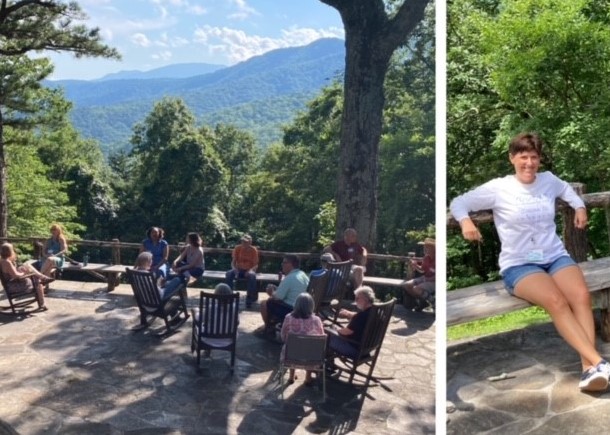
The patio at Wildacres
On the first afternoon I went looking for Linda and found her in the library talking with author Steve Cushman. I sat down with them, and we had a nice discussion about query letters, agents, and whether or not getting published is always the end-all, be-all. Steve and Linda both agreed that sales numbers can be a bit of a downer. We also just chatted about ourselves, our lives outside writing, and how we ended up at Wildacres. It was enjoyable, it was easy, and it set us up as “camp buddies.” This was the kind of thing that happened throughout the week, which was great and exactly as I’d hoped. It was daunting too, though, make no mistake; it’s one thing to know in theory that there are millions of other writers out there; it is another thing entirely to meet them face to face, to hear them read, and to discover how good they are.
Our workshop classes met for three hours each day – mine was focused on novel writing. It was comprised of about eight students led by author Tommy Hays, and we met in the mornings. Other classes were held after lunch, and we could audit those if we liked. Prior to coming, each of us in the class had sent 10-15 pages of a manuscript-in-work to all the others, and each day the entire class provided feedback and critique for two of them. The rest of the class time was spent discussing aspects of writing following chapters in Alice LaPlante’s The Making of a Novel. Sound English-classy? It was a bit. But we were such a small group, we were all plugged in and talking, and for me the time didn’t drag. I was honestly dubious about the LaPlante book, as I’m writing commercial, beachy stuff, not fine literature – but actually, these discussions did make me think more consciously about things like point of view, when to use dialogue and when not to, when to fill in the blanks and when to trust the reader to do that on his or her own. Better writing is just better, even for the beach. Most importantly for me, this was the first time I’d had real, in some cases professional, writers read my manuscript, and it was something that I needed. The format for critiquing had the author being reviewed (me, for example) sit silently while the class discussed the sample as if I was not there. It took some getting used to, but it was liberating for both sides. Not only were the comments helpful, but hearing all the general chatter was enlightening – for my piece, they all misinterpreted something and didn’t even know they had it wrong but, hearing them discuss it “amongst themselves,” I knew it was something I needed to fix. The individual follow-up by Hays was even better. He’s been around the block a long time, and his comments were spot on.
During our free time I did, of course, do some writing, but I also took advantage of the myriad hiking trails surrounding our compound. Some people drove to famous spots, but I loved literally walking out the door, down the entrance road, and picking a trail entrance. We were lucky – the week I was there, it was relatively cool for July, and these treks, while hot, weren’t sweltering.
In the evenings we all met in the auditorium for readings. At first it was only faculty, but in the middle of the week the rest of us could sign up for a slot. You got four minutes exactly, with a timer (and good-natured applause!) ushering off the stage anyone who ran over. Reading to an audience can be nerve racking, but this was an invaluable opportunity to practice. It was also a good way to get a sense of who was writing what, and on Thursday there was a book sale – anyone with published books was welcome to set up a table. I snagged a number of my fellow writers’ works, signed by the author of course, and I keep them all together now on a dedicated bookshelf. A local shop also brought books up for sale in the lodge, including some of the faculty’s publications, and these were available most of the time we were there.
After readings, we usually gathered again on the patio. A few nights we had music, and one night there was a dress up party. This was themed (ours was “magic on the mountain”), and we had been forewarned to bring a costume. Some people come back year after year, and you could see the closeness that had been forged amongst many of the attendees.
All in all it was a very enjoyable experience, and it matched nicely with my vision of what an organized writing retreat (workshop) would be. I would absolutely go again, but I’m also curious to see how other organizations run such things, or to attend one that is more genre specific. We’ll see what opportunities the coming years bring.
Tips: How do you find retreats? Just doing an internet search will yield an abundance of results, but for more personal recommendations, try taking a one-day class on book writing at your local community college or recreation center. These are usually very inexpensive, will teach you something, and not only the faculty member but also fellow students will likely be able to provide feedback from retreats they’ve experienced.
Happy Writing!
 AUTHOR Anne loiselle
Leave a comment